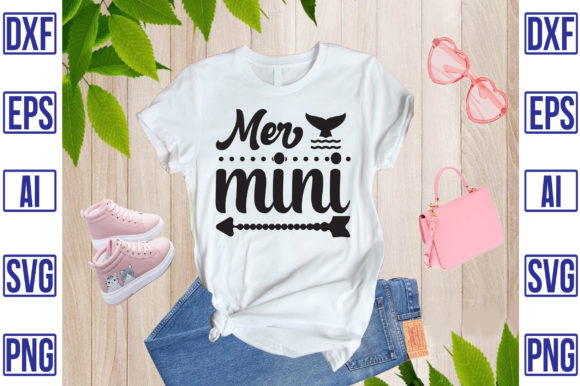
Mer Mini: T-Shirt Designs & Graphics for Creative Sellers
As someone who’s launched over 200 digital product listings across Etsy, Creative Market, and Shopify—and scaled a print-on-demand brand to six figures—I opened the Mer Mini download with one question in mind: Can this asset earn its place in a high-converting, cohesive collection? Not just as filler, but as a strategic graphic design asset that strengthens visual storytelling, supports brand consistency, and converts across multiple product types.
First impression? Mer Mini lands with quiet confidence. It’s not loud or trend-chasing—no neon gradients or exaggerated outlines. Instead, it carries a soft, intentional charm: rounded forms, balanced negative space, and subtle texture that reads well at both 2” and 24”. Think “hand-drawn elegance meets modern minimalism.” It leans gently feminine without being cutesy, calm without feeling sterile. That makes it ideal for audiences seeking mindful, small-batch aesthetics—think yoga studios, indie bookshops, botanical skincare brands, or cottagecore-themed planners.
For sellers building seasonal collections—say, a spring launch on Etsy or a Mother’s Day bundle on Creative Fabrica—Mer Mini works beautifully as a unifying thread. I tested it across eight real-world product formats: SVG-based Cricut iron-on transfers, PNG sticker sheets for printable planner kits, sublimation-ready mug designs, Canva template headers for digital greeting cards, t-shirt graphics (both classic crewneck and oversized fit mockups), nursery wall art prints, tote bag layouts, and Instagram Story highlight icons. In every case, it held up—not because it’s flashy, but because it’s designed to be used.
Where Mer Mini shines most is in presentation. On a clean white product mockup, its subtle contrast creates instant thumbnail appeal—critical when shoppers scroll past dozens of listings in under two seconds. Paired with a warm serif font like Playfair Display or a gentle sans like Montserrat, it builds perceived value fast. I also layered it into a digital paper pack background and used it as a focal point in a social media graphic promoting a new Canva template shop—no extra editing needed. Its visual hierarchy is intuitive: clear focal point, no competing elements, and enough breathing room to let surrounding text or branding breathe.
The file package is exactly what seasoned sellers need: one well-organized .zip containing production-ready assets—SVG for precise Cricut/Silhouette cutting, PNG with transparent background for stickers and overlays, EPS and AI for vector scalability in Adobe workflows, DXF for laser/cutting machines, and JPEG for quick web previews. No bloat, no redundant files, no confusing naming. That level of polish tells me the creator understands commercial design—not just illustration.
But realism matters. Mer Mini isn’t magic. It doesn’t solve poor listing strategy or weak branding. And it has boundaries. I tested it carefully on dark backgrounds—while the PNG transparency holds, fine interior details (like delicate line work inside the mermaid motif) can blur if placed over busy textures or low-contrast gradients. For Cricut users, I verified cut lines in Silhouette Studio: clean, closed paths, no stray nodes. But if you’re planning ultra-fine sticker decals under 1”, test the SVG at actual size first—some curves tighten when scaled down.
Also worth noting: Mer Mini doesn’t include built-in typography or color palettes. That’s a strength—not a gap. It gives you full control to match your brand’s voice. I paired it with a muted sage + cream palette for a wellness bundle, then swapped to terracotta + oat for a fall-themed digital download shop. Same asset, two distinct markets.
Before publishing any listing using Mer Mini, here’s my checklist—refined from years of customer support tickets and A/B tests:
- Preview it at 150% zoom in your marketplace thumbnail grid—does it still read clearly?
- Test the PNG on both white and charcoal backgrounds in Canva or Photoshop—check edge clarity and contrast.
- Open the SVG in your cutting software and run a “simplify path” check—confirm no overlapping vectors or open paths.
- Print a physical sample on matte cardstock and glossy sticker paper—verify color fidelity and detail retention.
- Drop it into three different Canva templates (a social post, a printable planner page, and a product label)—does it integrate naturally, or does it fight the layout?
- Confirm the commercial license explicitly permits finished goods (e.g., printed mugs, embroidered totes) and resale of digital bundles—don’t assume.
Where Mer Mini fits best: themed digital download shops, minimalist merchandise lines, printable wall art collections, Canva template kits with cohesive icon sets, and POD stores targeting thoughtful, values-driven buyers. Where it needs care: dense scrapbooking kits with 50+ elements per page, ultra-small die-cut vinyl stickers (<0.75”), or text-heavy packaging where visual noise competes with messaging.
One final note: Mer Mini isn’t a standalone hero—it’s a versatile supporting player. Used alone, it’s pleasant. Used intentionally—as part of a curated set of complementary design assets, consistent fonts, and intentional color stories—it becomes part of your small business branding architecture. That’s how you build trust, not just traffic.
If you’re preparing a new Etsy product, refreshing a print-on-demand catalog, or launching a seasonal digital download shop, Mer Mini earns a spot in your working folder. Not because it’s trendy—but because it’s reliable, adaptable, and quietly professional. And in digital product creation, reliability compounds faster than hype.